
Super SEs Don't Build Super Teams. This Does.

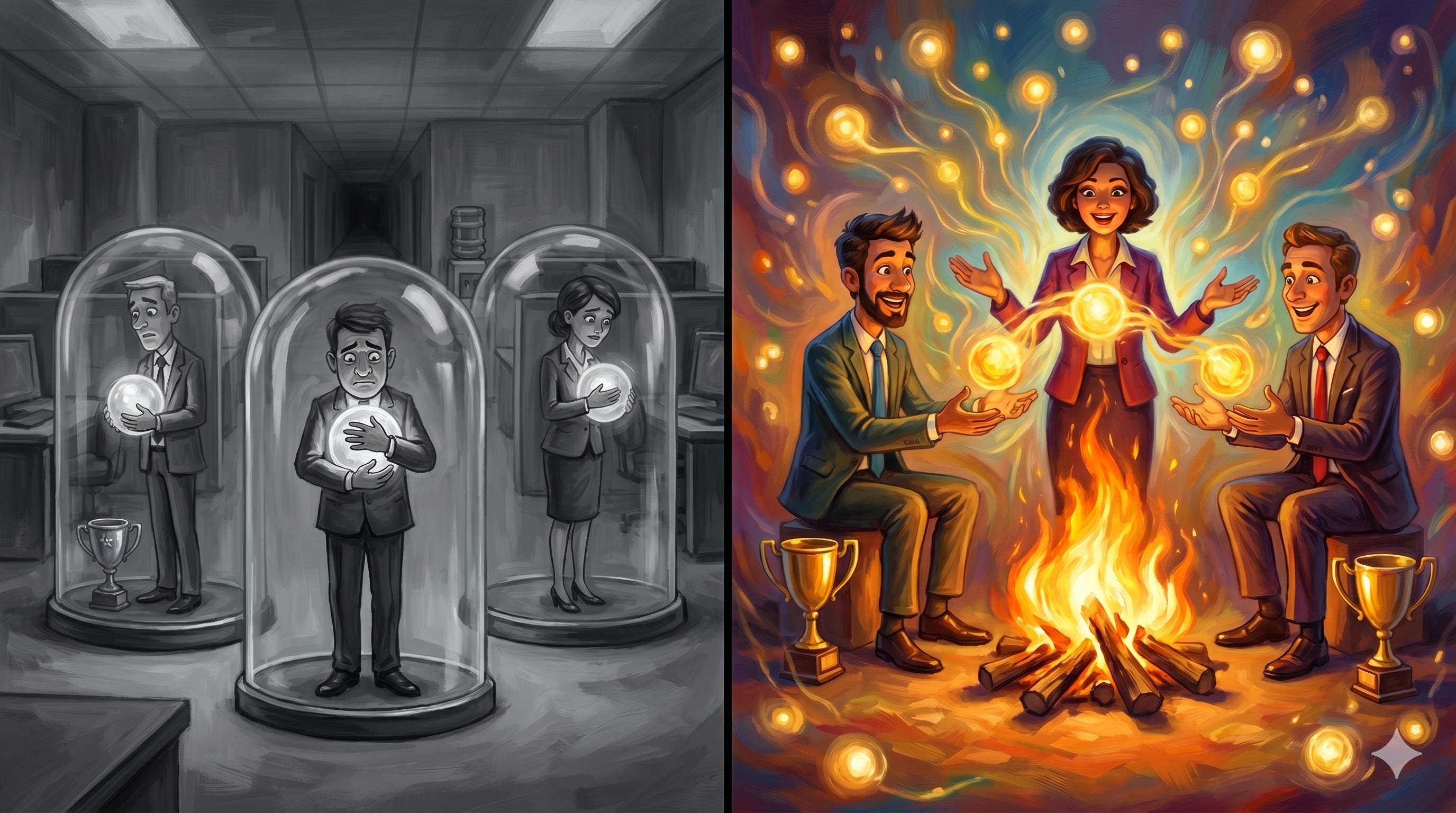
The SE mentor who changed how I think about collaboration was an army veteran.
I asked him once why everyone on his unit was so committed to sharing what they knew — not just the tactical stuff, but the reasoning behind decisions, the edge cases they’d learned the hard way, the things that weren’t written anywhere.
He looked at me like the question was strange. “If I kept that knowledge to myself and someone junior to me made a decision without it, they could die. That’s not hypothetical. That’s what happened to people who didn’t share.”
He carried that obligation into civilian tech work. Every new SE he worked with got the unfiltered version — not just how to do the job, but how to think in the situations where there was no playbook.
I’ve never forgotten that framing.
SE orgs are generating superhumans right now.
Take an already-elite SE — deep technical knowledge, strong discovery skills, sharp instincts — and pair them with AI that handles pre-call research in fifteen minutes, generates first-draft proposals, helps diagnose competitive positioning before the meeting. The productivity gain is real. Individual performance spikes.
And here’s the problem: most orgs stop there.
The tribal knowledge that elite SE develops in collaboration with their AI system — how they prompt, what context they bring, the mental models they’ve refined through hundreds of AI-assisted calls — stays locked inside one person’s workflow. It doesn’t get taught. It doesn’t propagate. When that SE leaves, it leaves with them.
You built a superhuman. You didn’t build a team.
The math changes when you make collaboration structural.
Research tracking thousands of enterprise sales deals found that team selling increases close rates by 258% compared to solo selling. Not a marginal lift — a fundamental change in win rate.
Frost & Sullivan found that companies where sales and technical teams actively shared knowledge saw a 27% increase in revenue and a 41% improvement in customer satisfaction.
i4cp studied 1,400 organizations and found that teams with precise, intentional collaboration saw a 39% productivity gain — with one organization realizing a half-billion-dollar economic impact from that shift.
The multiplier isn’t the star. It’s what happens when the star’s knowledge stops being a personal competitive advantage and becomes the new team floor.
The comp structure problem is real, and it works against this.
Most SE orgs have split comp — some portion tied to individual performance, some to team or quota. But the underlying culture often runs on a logic that individual output equals individual standing. You’ve mastered AI-assisted prep and developed a system that triples your throughput? Why would you teach that?
Research published in the Journal of Business Research last year found that high-intensity individual pay-for-performance consistently suppresses knowledge sharing. The incentive actively works against the outcome.
The NFL figured this out. The kicker who converts one field goal in the fourth quarter didn’t win the Super Bowl alone. Neither did the QB with the most passing yards. The ring goes to the team. The structure exists to reinforce that — and the culture follows the structure.
The orgs I’ve been part of that built genuine sharing cultures weren’t the ones with the best training programs. They were the ones where it was embarrassing not to share what you knew. Where teaching someone else didn’t make you less valuable — it made you more of one.
What this looks like in practice: an SE who figures out a dramatically better prompting workflow for discovery call prep brings it to the team sync. Another SE’s win on a tough competitive deal gets debriefed out loud, not just logged in Salesforce. The junior hire gets the unfiltered version of how senior SEs actually think — not just the approved playbook.
The tribal knowledge gets locked in, not locked up.
One AI-powered SE is powerful. A team where AI skills propagate, where learning spreads, where the floor keeps rising — that’s a different category of competitive advantage entirely.
My veteran mentor put it simply: the knowledge you don’t share is a liability. What does your team do to make sure the good stuff actually spreads?