
AI Didn't Just Make Me Faster. It Changed How I Think Across Roles.

Before AI pair programming, my coding life looked like most remote developer setups. Heads-down solo work most of the day. Collaboration at the seams — PR reviews, merge conflicts, sprint meetings. The interesting technical conversations happened in bursts.
I’ve been lucky. Most of the people I’ve worked with over the years have been genuinely good colleagues. That’s not a small thing, and it’s not what changed.
What changed was how I was thinking when I worked.
It started with Copilot — using it as a pair programmer, watching it suggest the next line, pushing back when it was wrong. Then a wider toolkit. Then writing in environments where AI was my main collaborator on the code itself.
What I didn’t expect was what that environment would train me to think like.
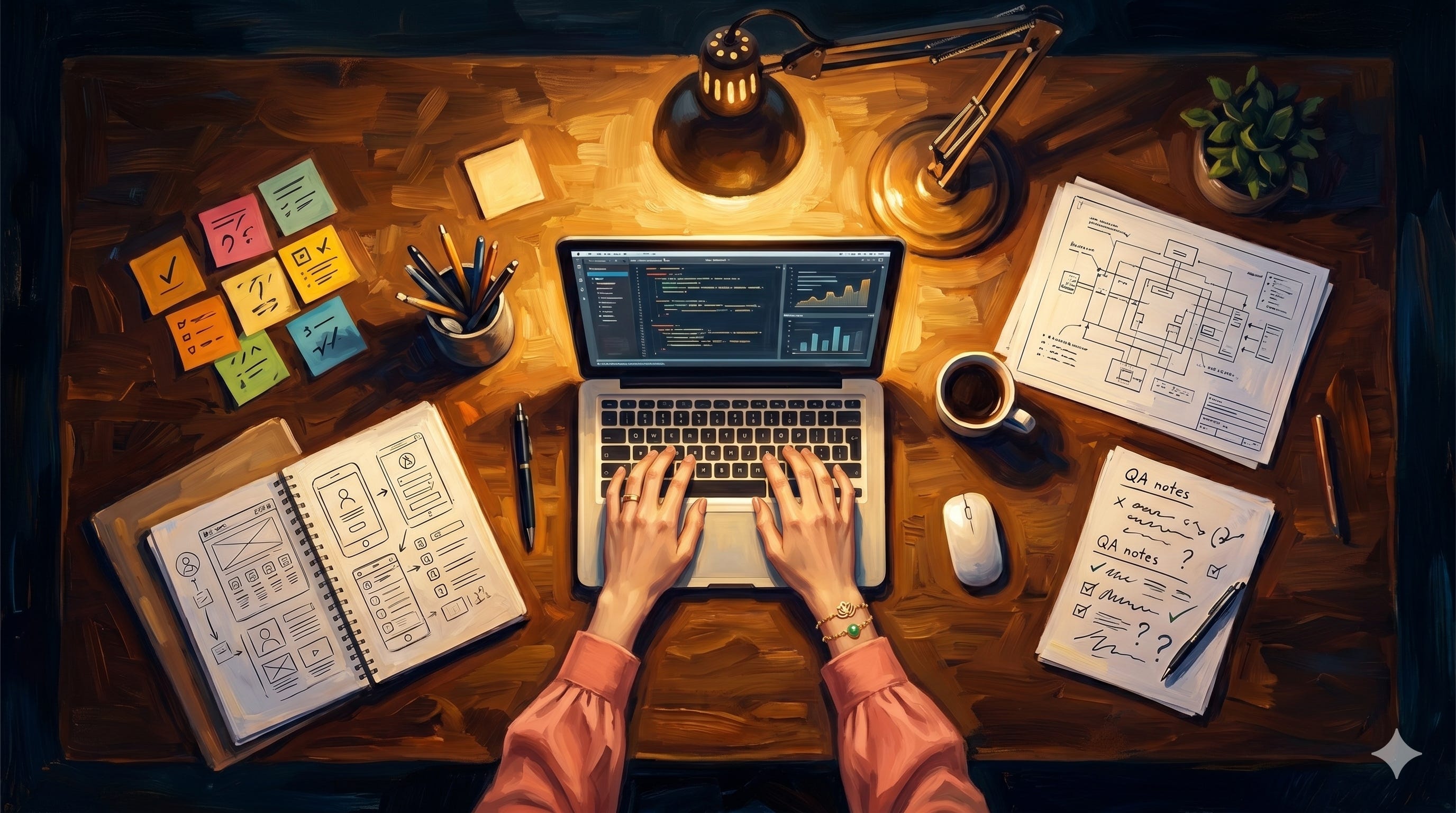
When you’re working with AI as your main collaborator, there’s no human to hand the QA to. No designer to spec the UX. No architect to validate the approach. No product manager to own scope. You hold all those questions yourself — not because you have those formal roles, but because the work doesn’t move forward unless you do.
I started thinking like a QA — catching my own edge cases. Like a UX designer — noticing immediately when something wasn’t working. Like a PM — making decisions about scope and priority that I’d previously deferred. The mental discipline wasn’t producing artifacts; it was holding many problems in mind at once and moving between them without losing the thread.
That’s the skill I didn’t know I was developing: thinking across PM, QA, UX, architect, and product-owner mindsets simultaneously, making fast decisions across all of them, and keeping the work moving.
There’s something else specific to AI collaboration that’s different from any other working relationship.
I can ask the same question five different ways in three minutes. I can explore a direction I’m unsure about without the overhead of explaining why. I can be completely direct about what’s not working without managing how it lands. Bad spelling, half-formed ideas, questions that feel too basic — none of it slows the loop down.
This isn’t better than human collaboration. It’s optimized for different things. Human collaboration is irreplaceable for judgment, context, and the nuance that comes from lived experience. AI collaboration is different: faster iteration, lower overhead in the creative loop, and a training ground for multi-role thinking that used to require a whole team.
The mental model this builds — priority, trade-off, decision, keep moving — is what fast-moving environments actually reward. Not a single specialization. The ability to hold many problems at once and keep moving.
That’s what working with AI for 2 years has taught me. And I don’t think I would have developed it any other way.
How has your working relationship with AI tools changed how you think — not just what you produce? I’m curious what other people are noticing
.